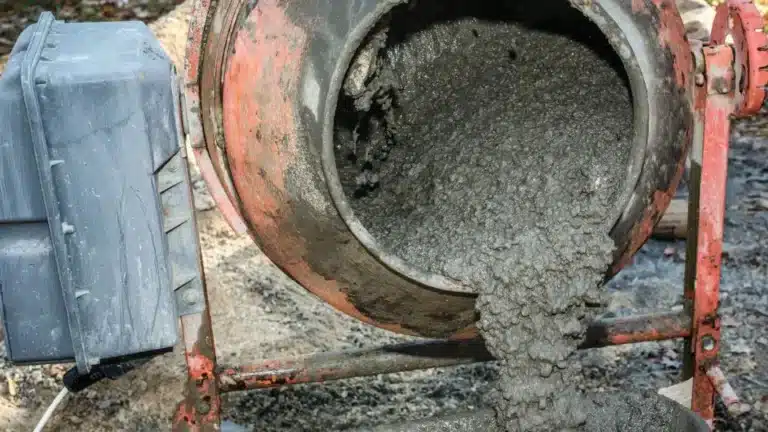
Concrete dust exposure happens on Australian construction sites every time concrete is cut, drilled, ground, jackhammered, or swept up. The dust from those tasks contains respirable crystalline silica, which is fine enough to travel through your nose and throat into the deepest parts of your lungs.
More than 500,000 Australian workers are exposed to respirable crystalline silica at work each year. Since 1 September 2024, provisions have applied to work with any substance containing crystalline silica, and they require risk assessment, written control plans, worker training, air monitoring, and health monitoring. The duty to control the dust belongs to the business running the job, and the duty to use those controls correctly belongs to you.
What is Concrete Dust?
Concrete is a mixture of cement, water, sand, and crushed stone. Once it has hardened, cutting, grinding, drilling, or breaking it releases very fine dust particles into the air. Concrete dust exposure involves two separate hazards.
Crystalline silica is a mineral found in sand, stone, and soil, and it is what makes concrete dust a lung hazard. The cement part of concrete dust is strongly alkaline, meaning it can mix with the moisture on your skin, in your eyes, and in your airways to form a caustic solution which can burn any tissue it touches. Cement powder is also extremely fine, with up to 50 percent of its mass small enough to be respirable, and it carries trace amounts of chromium that can trigger an allergic skin reaction in some people after repeated contact.
Silicosis and Other Hazards of Crystalline Silica Dust Exposure and Inhalation
Breathable crystalline silica particles settle at the base of your lungs, and your body has no way to remove them. Your immune cells attack the particles but cannot break them down which causes inflammation. Ongoing inflammation scars lung tissue which cannot recover.
Silicosis is a lung disease caused by inhaling these particles. Acute silicosis develops within a few weeks to a few years after short-term exposure to very high levels of silica dust. Accelerated silicosis develops after 3 to 10 years of moderate to high exposure and causes inflammation. Chronic silicosis follows prolonged exposure to lower levels and can cause those same lumps of scar tissue, breathlessness, and large scarring.
Concrete dust exposure has also been linked to the following health effects:
- lung cancer
- chronic bronchitis and emphysema
- kidney damage
- scleroderma, an autoimmune condition that hardens skin and internal organs
- a raised risk of tuberculosis
Even in the short term, inhaling cement dust irritates your nose, throat, and airways. High levels can cause coughing and breathing difficulty, and repeated exposure to cement dust may also reduce your lung function.
Preventing Cement Dust Inhalation

Preventing cement dust inhalation depends on stopping dust from becoming airborne where it is created. Australian WHS Regulations require the business running the work to eliminate the risk of exposure to respirable crystalline silica so far as is reasonably practicable, and to minimise any risk that cannot be eliminated.
Your employer must assess whether processing a crystalline silica substance is high risk before the work begins. If so, it requires a silica risk control plan in writing, or a safe work method statement where the job is high risk construction work. That document records the risk assessment for each task, the control measures chosen, how those measures are checked and reviewed, the training given, and the air and health monitoring arrangements. You must also be trained in the health risks of silica, how exposure occurs, and how each control operates.
Control measures are chosen in order, from the most reliable to the least, following the hierarchy of controls:
- Elimination removes the dust-generating task altogether, for example by ordering pre-cut or pre-cast pieces so that no cutting happens on site.
- Substitution replaces a high silica product with a lower silica alternative where an equivalent exists.
- Isolation separates people from the dust, using enclosed operator cabins with filtered air, physical screens, and exclusion zones.
- Engineering controls capture dust at the source, through on-tool water suppression, on-tool dust extraction, and local exhaust ventilation.
- Administrative controls change how the task is done, through written procedures, limits on how long each task continues, job rotation, and wet cleaning.
- Respiratory protective equipment protects only the person wearing it, and is used once the measures above are in place.
Uncontrolled processing is prohibited outright. Dry cutting, grinding, or polishing concrete without water suppression or dust extraction is not a permitted method of work, and a written procedure that names a mask as the only protection does not satisfy the regulations.
You have duties of your own under work health and safety law. You must take reasonable care for your own health and safety, take reasonable care that what you do does not put others at risk, follow reasonable instructions, and use every control provided as it was set up. If a control is missing, damaged, or not functioning, stop and report it before the task continues. Otherwise, use it exactly as your training and the written procedure describe, and ask for the safety data sheet of any product you are cutting so that you can check its silica content.
Enrol in White Card Training
Concrete dust exposure is among the most common airborne health risks in Australian construction, and every disease it causes can be prevented. Our White Card course leads to a statement of attainment for CPCWHS1001 Prepare to Work Safely in the Construction Industry, and it covers WHS legislation, site hazard identification, risk control, personal protective equipment, and emergency procedures. Enrol in our White Card course to gain the hazard and dust control knowledge Australian construction work asks of you.
FAQs
How Long Must Silica Health Monitoring Reports Be Kept?
Silica health monitoring reports must be kept for at least 30 years. Your employer must also give you a copy of your own report, and where it recommends a change to your duties, that change has to be made in consultation with you.
Does Smoking Increase Your Risk From Silica Dust?
Yes. Studies found that concrete dust exposure and cigarette smoking together raise lung cancer risk by more than the two risks would add up to separately.
What Should You Do If Cement Dust Gets In Your Eyes?
Flush your eye with flowing water for 15 minutes to remove all traces after concrete dust exposure, then seek medical attention.